Choose the course and your native language
Install LangBox, open its learning page and use the course selector in the upper-right corner. Choose the CEFR A2 core course. Set your native language in the learning settings so that available instructions and meaning hints use the language you understand. The target language for these exercises is English. Changing the interface language does not turn the course into a course for learning that language.
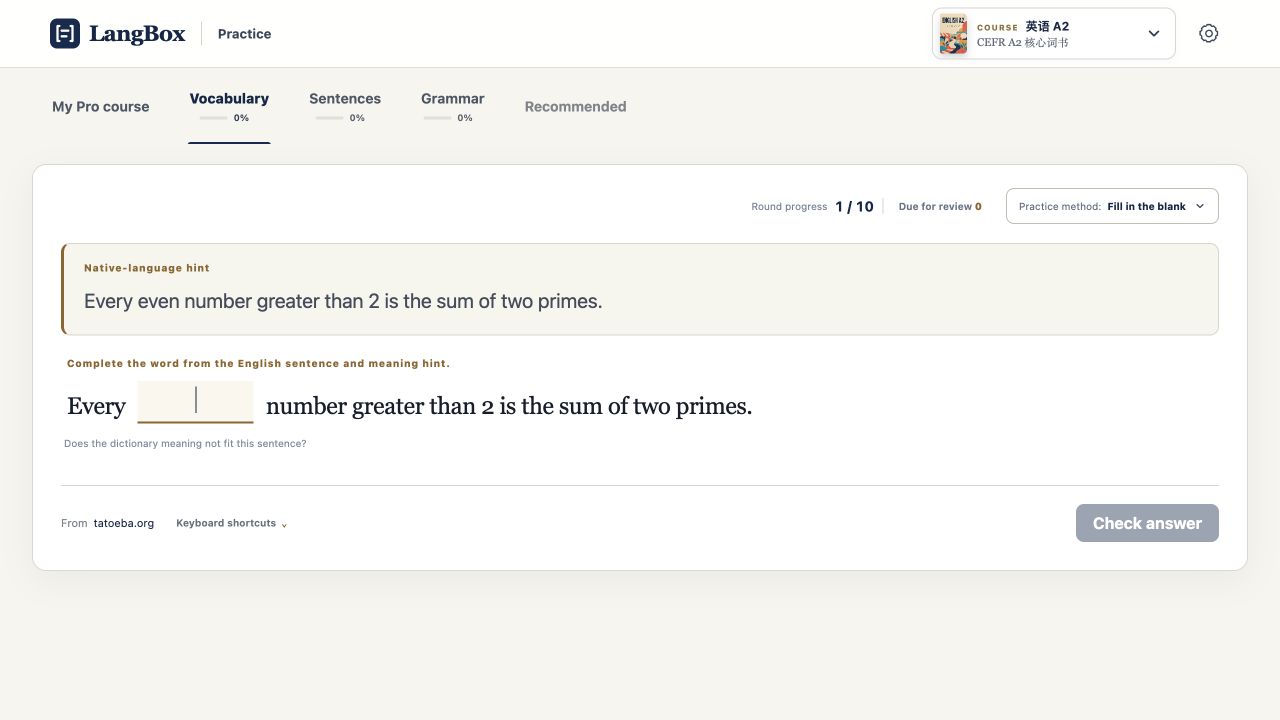
A2 broadly concerns familiar situations and straightforward everyday exchanges. A course label is a starting point, not a level certificate. An individual example can contain a difficult topic or unfamiliar vocabulary. If you cannot follow most of a sentence, use a simpler example or try A1 before continuing. The example below tests “even”, but its mathematical context is more specialised than everyday conversation.
Try the missing word before checking
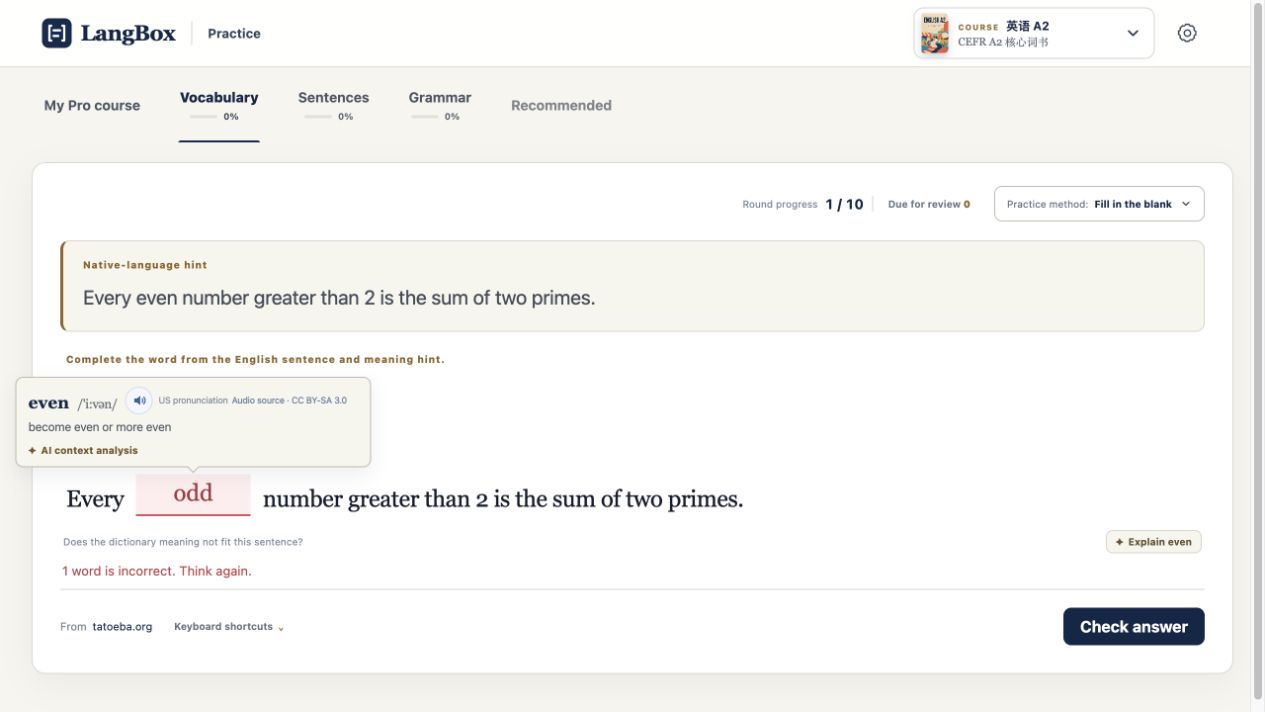
Read the complete sentence and the native-language hint, then type the missing word and select Check answer. In this captured exercise the intended word is “even”. In “an even number”, it means a number divisible by two. Entering “odd” produces an error. That is a useful distinction to practise: both are real words, but they express different meanings.
Do not assume every dictionary definition shown in a popup matches the current use. “Even” can be a verb, adjective or adverb; the captured English popup shows a different sense. Compare the definition with the sentence, its grammar and the translation. The “Does the dictionary meaning not fit this sentence?” control is visible in the interface. AI context analysis is a separate action and was not used in this walkthrough.
Distinguish recall from prompted completion
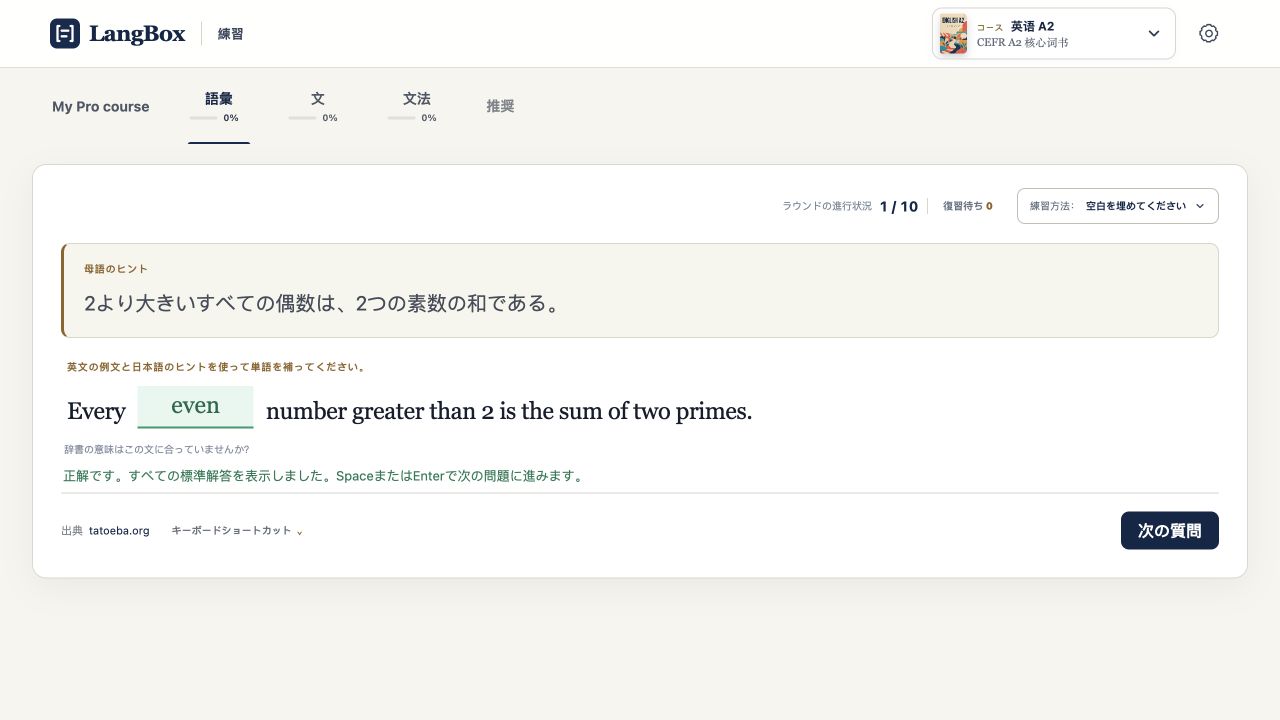
An answer entered correctly without using a hint has a different learning meaning from an answer copied after seeing the solution. The Japanese screenshot below shows an independent correct response. After a hint, the interface can instead describe the result as follow-along completion and mention a review record. Do not count those two experiences as the same evidence of recall.
After seeing a hint, type the answer yourself, read the sentence again and explain the meaning in your own words. Later, try the word in a fresh sentence without looking at the solution. If you can only recognise it immediately after seeing it, that is a reason to keep practising, not evidence that the word is mastered.
Build a sentence word by word
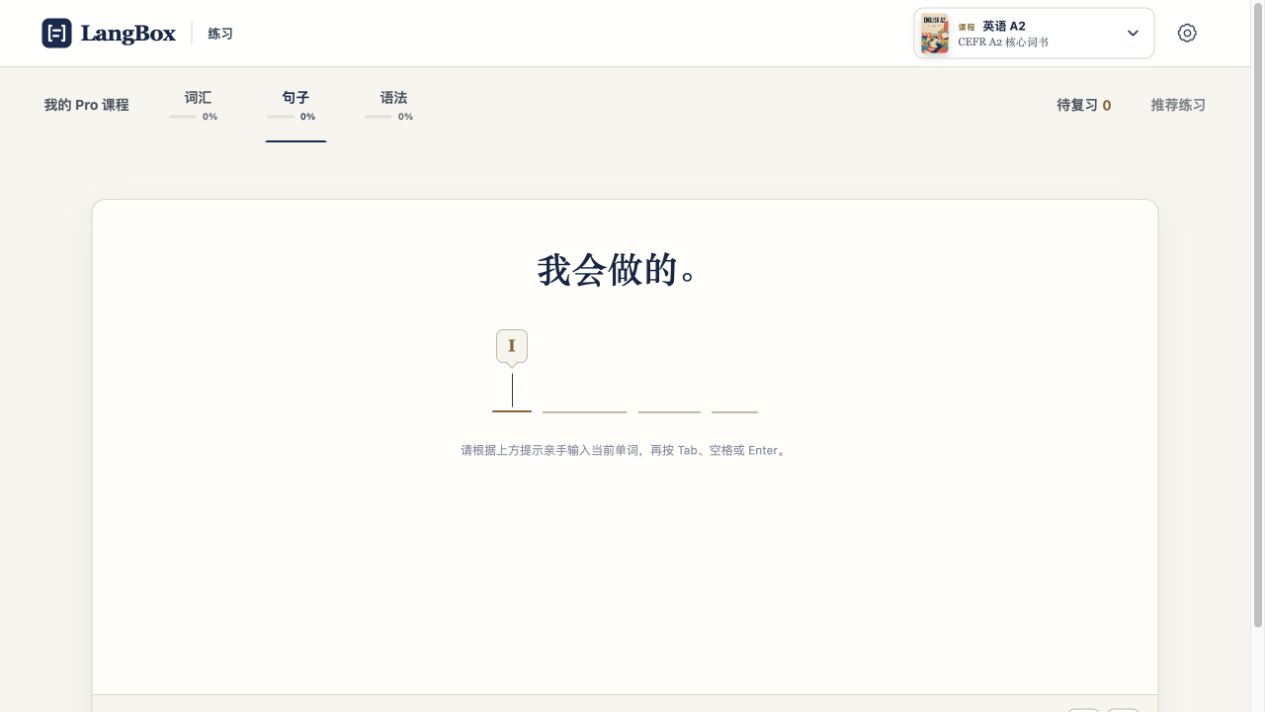
Where the sentence library is available for your native language, open Sentences. The captured prompt means “I will do it”. Fill the boxes from left to right. Tab, Space or Enter checks the current word. Shift+Enter reveals a hint for that word; you still need to type it yourself. An incorrect attempt shows a remaining-attempt message rather than immediately treating the sentence as complete.
This activity practises the course’s expected expression. Natural language may allow other valid phrasing, so a rejected alternative is not automatically bad English. Compare your wording with the target expression and the intended meaning. Keep the distinction between practising a particular pattern and evaluating unrestricted writing.
Check grammar availability before planning a session
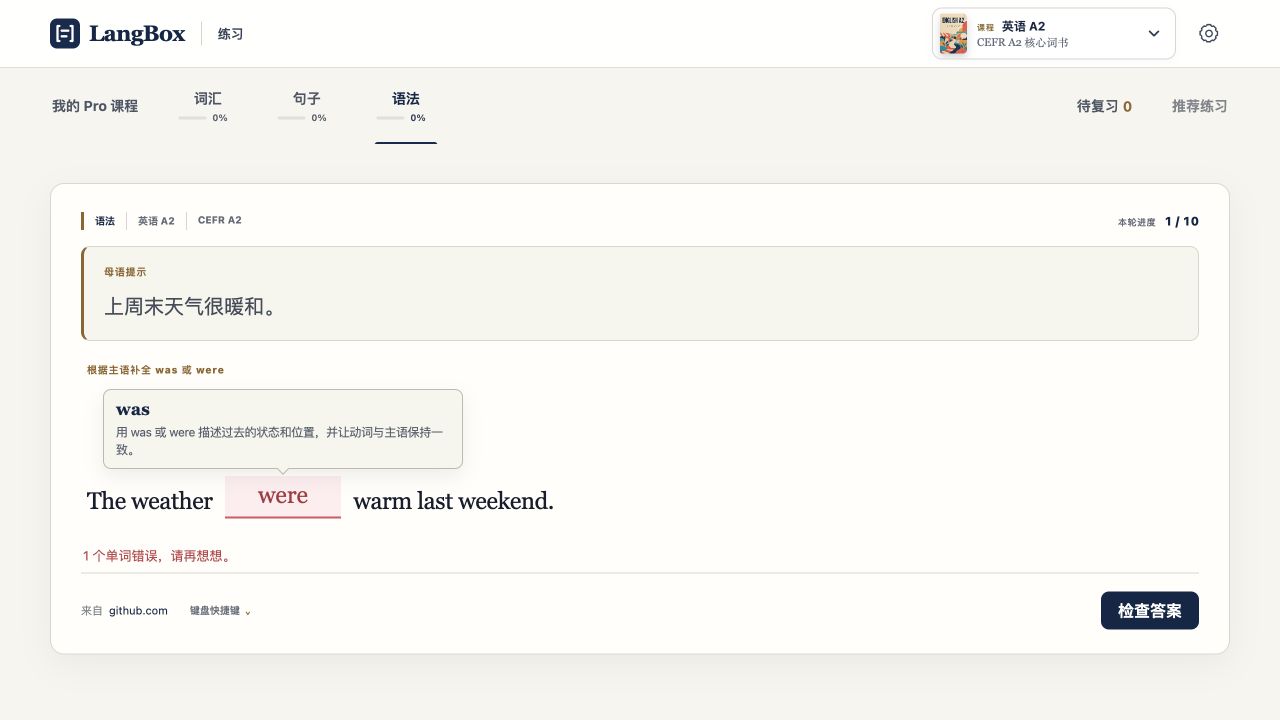
The Chinese A2 grammar example asks for “was” or “were”: “The weather was warm last weekend.” The subject is singular and the time is in the past. Entering “were” produces a hint about matching the verb to its subject. Correct the word and then make a second example with a plural subject, such as “The rooms were warm”. That second sentence is a suggested follow-up, not another captured app question.
A2 now provides 112 sentence questions and 40 grammar questions with content in all six supported native languages, verified on September 8, 2026. Choose your native language in learning settings before practising. A2 vocabulary uses cloze; the other vocabulary variants remain disabled in this course.
Keep the next session small and specific
A practical session can contain a few cloze attempts, one sentence you can produce without help, and one grammar contrast where that activity is available. Record which answers needed hints. Revisit those expressions later instead of increasing the number of exercises simply because the interface shows a completed round.
Course practice is separate from looking up words while reading a webpage. A lookup does not promise that a new exercise will automatically be generated. For reading practice, use the technical-document walkthrough linked below and choose material you can mostly understand. IELTS reading and listening belong to a separate course; their screenshots and difficulty should not be described as A2.